Heraldry and Motto
Symbols matter only
when they are lived.
Heraldry belongs to the memory of a house, but also to its present discipline. Arms, motto and insignia are not used here as decoration. They are received as signs of continuity, belonging, responsibility and measure.
Heraldry
A language of continuity
Motto
Ordo ab chao
A first clarification
A coat of arms is not the soul of a house. It is one of the ways a house remembers, declares and disciplines itself.
What heraldry means
Heraldry is the visual grammar of continuity.
Historically, heraldry allowed houses, lineages and institutions to identify themselves through recognised signs. Arms, crests, mottos, seals and insignia carried memory, standing and belonging into public and private life.
Yet heraldry was never only about visual distinction. It also expressed responsibility. A symbol made a house legible, and in doing so it placed that house under the obligation to be worthy of what it claimed.
This is why heraldry remains meaningful only when it is joined to conduct.
Principle
Here, heraldry is not treated as ornament.
It is treated as disciplined inheritance.
The symbols of the house are not displayed in order to enlarge appearance. They are preserved because they belong to the moral and historical continuity of the family, and because they remind the present generation that form without substance quickly becomes emptiness.
The arms of the house
A sign of belonging, memory
and public legibility
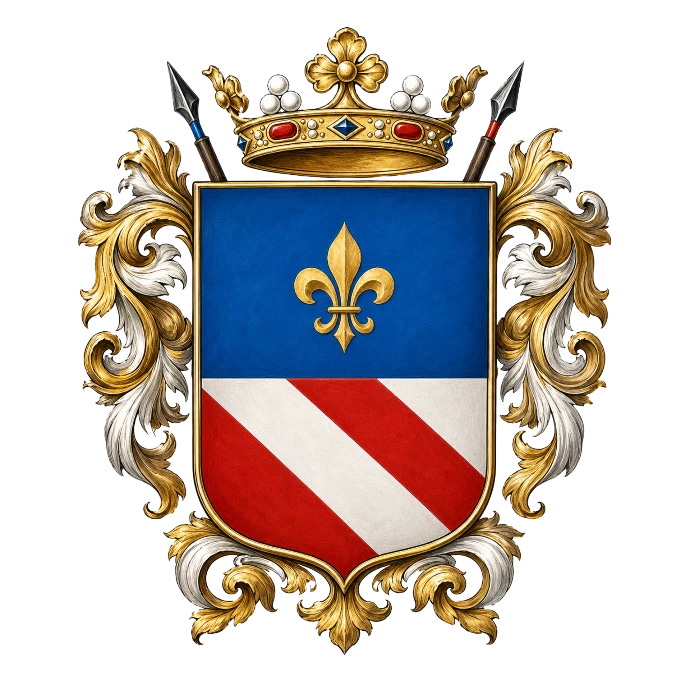
The Pavan arms
The arms of the house are preserved here as part of the continuity of family identity. They are a formal sign through which the house recognises itself across time and makes that continuity visible without reducing it to biography or narrative.
On this site, the arms serve as a point of orientation. They gather memory, authority, inheritance and responsibility into a single recognisable sign.
Their presence is therefore not decorative. It is declarative, in the sober sense of the word.
The family motto
Ordo ab chao
For this house, the motto is not a phrase to be admired from a distance. It is a standard of interpretation and conduct.
Order
Not rigid control, but intelligible form. Order means clarity, proportion, reliability and the ability to make life, duty and responsibility more coherent.
Chaos
Not a romantic disorder, but the confusion, fear, fragmentation and opacity through which people and institutions lose direction, confidence and trust.
Meaning
The motto points to a human duty: to bring structure where there is confusion, direction where there is uncertainty, and dignity where systems have become cold or inaccessible.
A renewed interpretation
In the present century, the motto must be lived through service.
For Paolo Maria Pavan and Linda Pavan, Ordo ab chao cannot remain confined to symbolic inheritance. It must be translated into practical usefulness. It must speak to younger generations, to smaller builders, to entrepreneurs under pressure, to those facing institutional complexity without enough guidance or trustworthy support.
The motto therefore becomes a principle of stewardship: helping create better conditions for clarity, governance, ethical seriousness, risk awareness, cultural understanding and human dignity.
This means
helping structure emerge without extinguishing courage;
helping seriousness grow without becoming hardness;
helping institutions become clearer rather than more intimidating;
and helping continuity become useful rather than merely ceremonial.
Conduct
The motto is credible only when behaviour confirms it.
Heraldry and motto have value only if they are reflected in the way a house answers, receives, preserves, guides, supports and carries responsibility. Symbols without conduct become posture. Conduct without memory becomes rootless. The task of the present is to keep the two together.
Why preserve these symbols
Because form can still educate the present
Memory and belonging
Symbols preserve continuity across time. They help a house recognise itself, remember what it has received, and resist the erosion that comes when everything is reduced to temporary appearance or purely private feeling.
Measure and restraint
Preserved properly, heraldry teaches proportion. It reminds the present that identity should be carried with discipline, not noise. It calls for seriousness, not display.
Documentary note
This page presents the symbolic life of the house in a spirit of continuity and due measure.
It does not attempt to turn heraldry into spectacle, nor to substitute symbols for substance. It simply preserves and explains those elements of family identity that continue to matter because they remain linked to memory, responsibility and living interpretation.
Closing note
The worth of a symbol depends on the worth of the life that carries it.
This is why heraldry still belongs to the present life of the house. Not because it flatters memory, but because it disciplines it.
And this is why Ordo ab chao remains not only a motto, but a demand.